
CVD diamond is chemical vapour deposition diamond (also called CVD diamond film or diamond thick film). It is another significant revolution in the synthetic diamond field after the synthesis of diamond under high temperature and high pressure. Its size can be great, currently reaching 120 mm in diameter and 2 mm in thickness in mass production, and the crystal quality can be compared with natural IIa diamond. Under low-pressure conditions, carbon-containing gases such as CH4 and C3H8 pyrolyse; then, with the effect of activating radicals such as H+ and OH, pure polycrystalline diamond is deposited on solid substrates. The main synthesis methods for CVD diamond films include hot-filament CVD, DC arc plasma jet CVD, microwave plasma CVD and DC hot-cathode plasma CVD. Among these, DC arc plasma jet CVD offers fast speed and good quality, which makes it very suitable for the production of tool-grade diamond thick films.
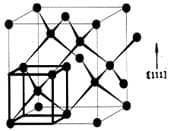
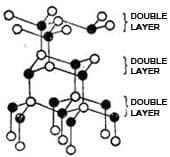
CVD diamond has a face-centred cubic structure, as shown in the figures below. The diamond Bravais cell includes two carbon atoms. In a face-centred cubic cell, four carbon atoms are located at the 1/4 positions of the space diagonals. Every carbon atom is covalently bonded to four surrounding carbon atoms, one of which sits at the centre of a regular tetrahedron. The bond orientations of the four carbon atoms at the tetrahedron centre differ from those of the carbon atoms at the apex angles, so the surroundings of the carbon atoms at the cube corners and face centres differ from those of the four carbon atoms on the diagonals. Therefore, although diamond is composed only of carbon atoms (natural diamond contains 98.9% 12C and 1.1% 13C), its structure is a duplex lattice formed by two overlapping face-centred cubic sub-cells shifted along the space diagonal by 1/4 of its length. The lattice constant is 3.56 Å and the bond length is 1.54 Å. Because of the compact crystal structure, small carbon atom radius and short bond length, diamond is extremely hard.
Diamond can be divided into types Ia, Ib, IIa and IIb in terms of physical properties. In Ia diamond the nitrogen concentration is high (on the order of 1/1000) and exists as anti-paramagnetic aggregates. Such diamond has good mechanical properties, high electrical insulation and a narrow light transmission range. The nitrogen concentration in Ib diamond is also fairly high, but exists in a paramagnetic form; the thermal conductivity of Ib diamond is better than that of Ia diamond. IIa diamond has an extremely low nitrogen concentration, the highest thermal conductivity and the widest transmission band. IIb diamond contains boron and behaves as a P-type semiconductor. At present, IIb diamond can be synthesised by CVD.